


- E-mail: sales8@micmachinery.com
- Mobile: 0086-13083991987
- Whatsapp: 0086-13083991987
- Wechat: 0086-13083991987
- Shipment: exporting country
- Customer reviews: click on
MIC 12-12-1 Beer Glass Filling Machine (800-1500BPH)
Beer loses its edge fast once oxygen gets involved. That is the core problem a proper beer glass filling machine has to solve, and it is why aseptic, isobaric filling exists in the first place. The MIC 12-12-1 was built around German filling technology and adapted for the production conditions common in Chinese breweries, combining rinsing, filling, and capping into one synchronized system for glass bottles.
This is not a bar-side pouring unit. It is production equipment designed to move sterile beer into a sterile glass container without exposing the product to outside air during the fill, which is the detail that actually protects flavor, carbonation, and shelf life once the bottle leaves your facility.
How Isobaric Filling Protects the Beer
Standard filling pushes liquid into a container that is still at normal pressure, which causes foaming and CO2 loss with any carbonated beverage. Isobaric filling equalizes the pressure inside the bottle to match the filling tank before liquid ever enters, so beer goes in without excess foam and without losing dissolved gas along the way. The MIC 12-12-1 runs this process at low temperature as well, which keeps carbonation more stable through the fill and reduces oxygen pickup that would otherwise shorten shelf life.
The rotary filling wheel is built entirely from SUS304 stainless steel, and the filling valves themselves use SUS316L, a higher-grade alloy chosen for its resistance to the acidic and alcoholic properties in beer over repeated cleaning cycles. Bottles move up through a cam-driven elevator to make contact with the filling valve, a mechanical approach that keeps fill height consistent bottle after bottle rather than relying on timed dosing alone.
Washing and Capping Built Into the Same Line
Before filling, each bottle is inverted and centered above a spray nozzle that rinses the interior with water, then drains and returns upright before moving to the filler. This step removes dust and residual particles that would otherwise compromise a sterile fill, and running it inline means you are not adding a separate washing station or extra labor to the process.
Capping uses a photocell switch on the cap distributing chute, which stops the capper automatically if the chute runs empty, along with an inlet bottle detection switch that prevents the capping head from firing without a bottle present. Both details reduce the equipment damage and wasted caps that come from running a line unattended during a supply gap.
Automatic Glass Bottle Filling Machine Components
An automatic glass bottle filling machine at this level depends on the quality of its electrical components as much as its mechanical design. The PLC and touch screen run on Siemens, push buttons and electromagnetic contactors are Schneider, relays are Omron, and the pneumatics run on AirTAC. Photoelectric and proximity switches come from Autonics. We source these specific brands across our full filling equipment range, which means a replacement part for this machine is easy to find years after your original purchase, not something you have to special-order from a single supplier.
What a Glass Filling Machine Actually Needs to Get Right
A glass filling machine built for beer carries higher stakes than one built for still beverages. Carbonation loss, oxygen pickup, and foaming are all avoidable problems, but only if the filling system is designed around them from the start rather than adapted from equipment built for water or juice. That is the gap this machine was built to close, using isobaric filling and low-temperature control as standard features rather than optional upgrades.
This machine pairs naturally with the rest of a brewery's packaging line. If you already run a beer can filling machine for part of your product mix, this unit lets you add glass bottle packaging without duplicating your filling infrastructure from scratch. Many craft beer filling machine setups follow this same pattern, running cans and bottles from separate lines that share a common bottling philosophy around sterile, low-oxygen filling.
Ready to Buy a Beer Glass Filling Machine?
If you are ready to buy beer glass filling machine equipment for your bottling line, we manufacture the core mechanical systems in-house at our Zhangjiagang facility, which keeps quality control tight and support direct once your machine is running. We also build a full range of beer filling machine configurations for canning and other packaging formats, so you can source a complete production setup from one supplier.
Send us your target output, bottle size, and product type, and we will put together a configuration and price built around your actual line. If you are comparing this against a beer filling machine built for a different container format, tell us your full packaging mix and we can help you land on the right setup for your brewery, including whether a shared craft beer filling machine platform makes sense for your production volume alongside a dedicated beer can filling machine line.
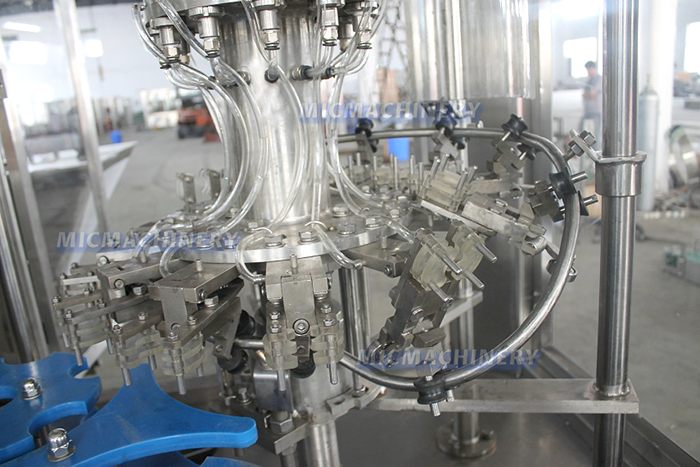
Washing Part
Washing part is mainly composed of washing pump, bottle clamps, water distributor, up turn-plate, guide rail, protection cover, spraying device, defrosting tray, rinse water take and rinse water refluxing tank.
The bottle is turned upside down and centered above a spraying nozzle which directs a stream of rinse water into the bottle. After the draining period the bottle is turned over to an upright position again.

Filling Part
Filling part is mainly composed of filling barrel, filling valve (low temperature and isobar filling), bottle hanging device / bottle pedestals, guide rail, elevating device, liquid indicator, pressure gauge, pressure regulator, etc.
Rotary wheel fully made of stainless steel SUS 304. Filling valves are made of SUS316L. Filling valves are reasonably structured with accurate filling. Bottles go up and down in the function of cam through elevator, to process filling with contact to bottle-mouth.

Capping Part
Capping part is mainly composed of capping heads, cap loader (separated), cap unscrambler, cap drop rail, pressure regular, cylinder and also we need an air compressor as the auxiliary external equipment.
Cap distributing chute is equipped with a photocell switch to stop the capper when there is no cap inside the chute. The capper is equipped with inlet bottle detection switch.

|
Model No. |
XGF12-12-1 |
XGF18-18-1 |
XGF18-18-6 |
XGF24-24-6 |
|
Rinsing heads |
12 |
18 |
18 |
24 |
|
Filling heads |
12 |
18 |
18 |
24 |
|
Capping heads |
1 |
1 |
6 |
6 |
|
Filling speed |
500-1000BPH |
800-1500BPH |
2000-4000BPH |
4000-5000BPH |
|
Model No. |
XGF32-24-6 |
XGF32-32-8 |
XGF72-72-8 |
|
|
Rinsing heads |
32 |
32 |
72 |
|
|
Filling heads |
24 |
32 |
72 |
|
|
Capping heads |
6 |
8 |
8 |
|
|
Filling speed |
6000-8000BPH |
4800-7500BPH |
10000-25000BPH |
|
|
|
Name |
Brand |
|
1 |
Push Button |
Schneider France |
|
2 |
Electromagnetic Contactor |
Schneider France |
|
3 |
Relays |
Omron Japan |
|
4 |
Frequency Converter |
Siemens |
|
5 |
Air Cylinder |
AirTAC Taiwan |
|
6 |
Electromagnetic Valve |
AirTAC Taiwan |
|
7 |
PLC Control System |
Siemens |
|
8 |
Touch Screen |
Siemens |
|
9 |
Photoelectric Switch |
Autonics |
|
10 |
Proximity Switch |
Autonics |
|
11 |
Reducer |
Zhejiang Duoli China |
|
12 |
Sealing Motor |
Zhejiang Duoli China |
|
13 |
Barometer |
AirTAC Taiwan |
|
14 |
Bearing |
Harbin China |
Products
- Beer Filling Machine
- Juice Filling Machine
- Soda Filling Machine
- Drink Filling Machine
- Carbonated Soft Drink Filling Machine
- Beverage Filling Machine
-
Labeling Machine
- Round Bottle Labeling Machine
- Shrink Sleeve Labeling Machines
- Shrink Sleeve Machine Shrink Label Machine
- Shrink Sleeve Applicator Packaging Machine
- Can Sleeving Machine
- Shrink Sleeve Packaging Machines
- Hot Melt Glue Labeling Machine
- Self Adhesive Labeling Machine
- Laser Coding Machine
- Other Types Of Labeling Machines
-
Packing Machine
- Wrap Packing Machine
- Case Packing Machine
- Blow-drying Machine
- Depalletizer
- Carbonated Drink Mixing Machine
- Pasteurization Machine
- Liquid Nitrogen Dosing Machine
- X-Ray Liquid Level Detection Machine
- Weight Detector
- Metal Detector Food Industry
- Aseptic Liquid Nitrogen Dosing Machine
- Palletizer
- Pallet Wrapping Machine
- Bottle Blowing Machine
- Semi Auto Bottle Blowing Machine
-
Beer Beverage Filling Machine
- Can filling machine
- Glass bottle filling machine
- Pet bottle filling machine
- Beer Filling Machine
- Beer Can Filling Machine
- Beer Bottle Filling Machine
- Semi Automatic Beer Filling Machine
- Soda Filling Machine
- Soda Bottling Machine
- Juice Filling Machine
- Juice Can Filling Machine
- Beverage Filling Machine
- Carbonated Drink Filling Machine
- Edible Oil Filling Machine
- Water Filling Machine
- Aseptic Cold Filling Machine
- Blowing Filling Capping Machine
- Beverage Processing Equipment
- Auxiliary equipment
Products
Application
- Beer filling machine solution
- Carbonated drink filling machine solution
- Soda water filling project solution
- Edible oil filling project solution
- Beverage filling equipment
- Drink water packing machine
- Beverage bottling equipment
- Automatic beverage filling machine
- Cold drink filling machine
- Water filling machine
Mic Info
Contact Us
- E-mail : sales8@micmachinery.com
- Address : 2224 Wukesong Road, Sanxing town, Zhangjiagang, Jiangsu, China
- Office Address: Building 22 Lansheng Phoenix IndustrialPark, No.8 Jifu Road, Zhangiiagang
- Whatsapp / Tel : 0086-13083991987

Copyright © Zhangjiagang Micmachinery.co.,ltd
Technical by Singoo
Product Catalog
- Beer Filling Machine
- Juice Filling Machine
- Soda Filling Machine
- Drink Filling Machine
- Carbonated Soft Drink Filling Machine
- Beverage Filling Machine
-
Labeling Machine
- Round Bottle Labeling Machine
- Shrink Sleeve Labeling Machines
- Shrink Sleeve Machine Shrink Label Machine
- Shrink Sleeve Applicator Packaging Machine
- Can Sleeving Machine
- Shrink Sleeve Packaging Machines
- Hot Melt Glue Labeling Machine
- Self Adhesive Labeling Machine
- Laser Coding Machine
- Other Types Of Labeling Machines
- Round Bottle Labeling Machine
-
Packing Machine
- Wrap Packing Machine
- Case Packing Machine
- Blow-drying Machine
- Depalletizer
- Carbonated Drink Mixing Machine
- Pasteurization Machine
- Liquid Nitrogen Dosing Machine
- X-Ray Liquid Level Detection Machine
- Weight Detector
- Metal Detector Food Industry
- Aseptic Liquid Nitrogen Dosing Machine
- Palletizer
- Pallet Wrapping Machine
- Bottle Blowing Machine
- Semi Auto Bottle Blowing Machine
- Wrap Packing Machine
-
Beer Beverage Filling Machine
- Can filling machine
- Glass bottle filling machine
- Pet bottle filling machine
- Beer Filling Machine
- Beer Can Filling Machine
- Beer Bottle Filling Machine
- Semi Automatic Beer Filling Machine
- Soda Filling Machine
- Soda Bottling Machine
- Juice Filling Machine
- Juice Can Filling Machine
- Beverage Filling Machine
- Carbonated Drink Filling Machine
- Edible Oil Filling Machine
- Water Filling Machine
- Aseptic Cold Filling Machine
- Blowing Filling Capping Machine
- Can filling machine
- Beverage Processing Equipment
-
Auxiliary equipment